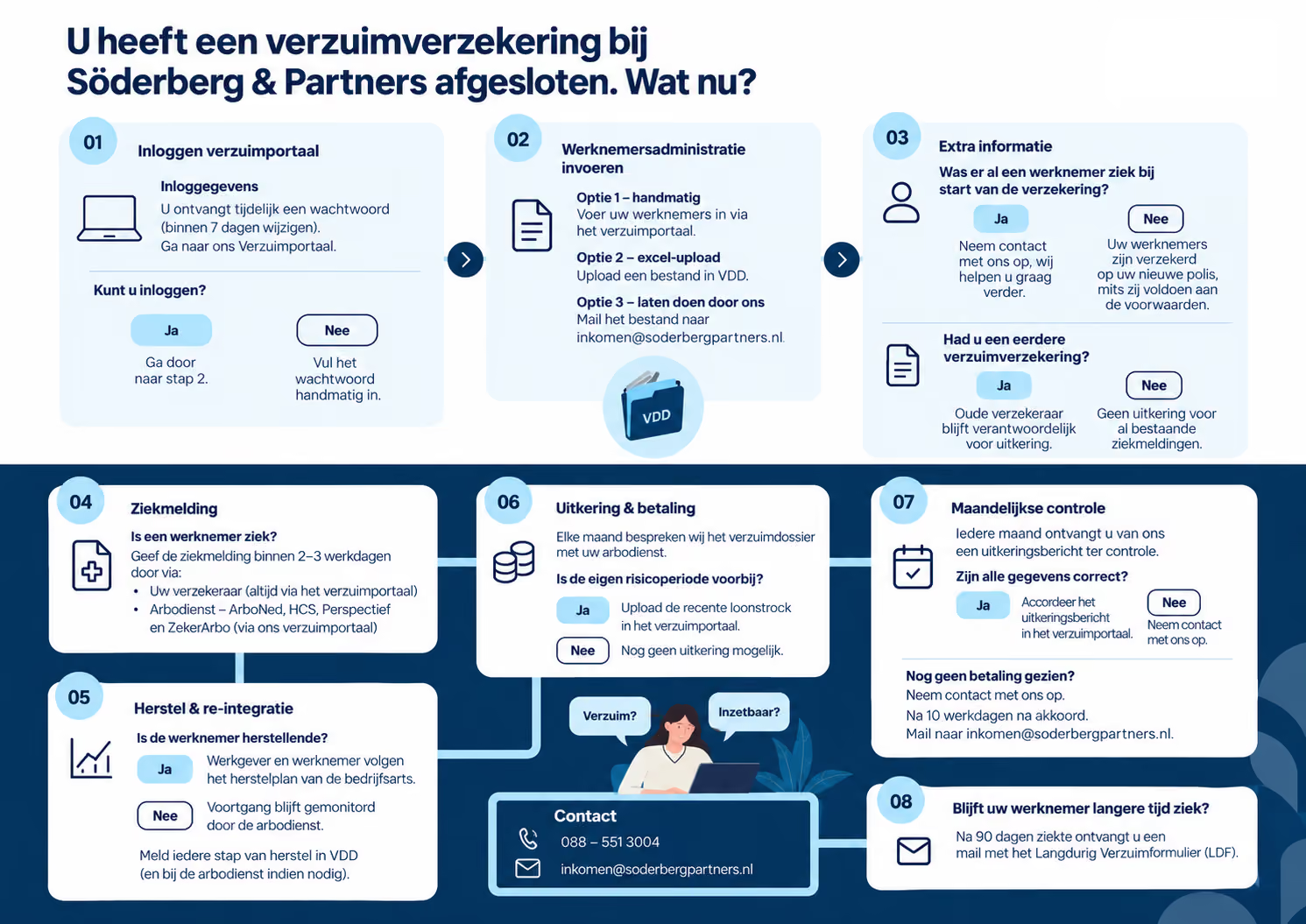
When an employee falls ill, you as an employer are in many cases required to continue paying their salary for up to 104 weeks. In addition, the Gatekeeper Improvement Act (Wet verbetering poortwachter) sets requirements for the guidance and reintegration of employees.
Absenteeism can therefore lead to:
- continued salary payments during illness
- costs for replacement
- loss of productivity
- increased workload within teams
- reintegration obligations
- administrative burdens
That is precisely why it is important to have insight into the risks and potential solutions in advance.
Get a grip on absenteeism and employability
A good approach to absenteeism involves more than just financial protection. It starts with insight into the risks within your organisation and the question of how to keep your employees sustainably employable.
Together, we look at topics such as:
Mapping absenteeism risks
What risks are present within your organisation? And what financial consequences could these have?
Sickness absence insurance
An absenteeism insurance policy can help cover the financial consequences of continued salary payments during illness. Various options are available, for example regarding waiting days and deductibles.
Reintegration and case management
Effective guidance for sick employees helps to limit absenteeism and meet legal obligations. Choosing to self-insure for WGA and the Sickness Benefits Act (Ziektewet) can also impact your responsibilities regarding guidance and reintegration.
Prevention and sustainable employability
Prevention is often better than cure. That is why more and more employers are focusing on measures that contribute to healthy, engaged, and employable staff. Read more about absenteeism and sustainable employability.
Personal advice for employers
Every organisation is different. The risks faced by a logistics company, for example, differ from those of a consultancy firm or a construction company.
That is why we always look at your specific situation, such as:
- the size of your organisation;
- the number of employees;
- the sector in which you operate;
- the current level of absenteeism;
- the financial risks you want to cover.
This creates a solution that fits your organisation and ambitions.